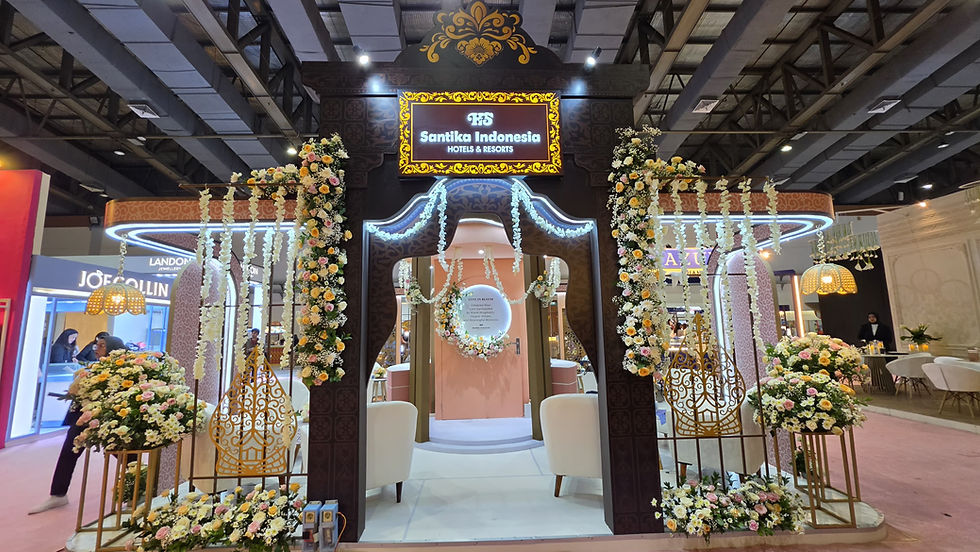
Space Optimization & Modular Architecture: Getting More Value From Every Square Meter in Indonesia’s Exhibition Scene

In Indonesia’s exhibition scene, space is no longer just a physical area. It is one of the most expensive marketing investments a brand makes.
Across venues in Jakarta, Bandung, Surabaya, and Bali, the challenge feels familiar. Booth rental costs keep going up, while usable space often feels smaller than expected. Layout restrictions, traffic rules, and crowded exhibition floors all play a part. For marketing and procurement teams, this makes every exhibition decision harder to defend internally, especially when results are closely reviewed by management (UFI, 2024).
Yet many brands still approach exhibitions with the same old thinking. Bigger booth equals bigger impact. When space becomes tight, the usual response is to downsize quickly, simplify the design, or use generic booth systems that are fast but forgettable.
Brands that perform better take a different path. They understand that today, success is not about how big your booth is. It is about how well every square meter works for you.
The Space Reality in Indonesia’s Exhibition Market
Indonesia’s exhibition market is growing fast, and that growth comes with trade-offs.
Demand for well-known venues keeps increasing, which naturally pushes rental prices higher. At the same time, fixed booth grids and venue layouts reduce flexibility, often leaving exhibitors with less usable space than planned (UFI, 2024; JIExpo, 2023).
This puts event teams under pressure. Budgets grow, space feels tighter, and expectations for results stay high. Many brands respond by accepting lower visibility or building custom booths that look great once, but are costly and hard to reuse.
Both options usually lead to the same outcome. High spending, limited flexibility, and unclear long-term value.
A smarter approach starts by changing how we look at space. Instead of treating it as a limitation, it becomes something that can be designed and improved.
Modular Architecture: Not Just About Saving Money
Modular architecture uses standardized components that can be rearranged and reused across different events, venues, and booth sizes.
Some people see modular systems as a budget option. In reality, their biggest strength is flexibility.
Industry research shows that reusable modular exhibition systems can lower total build and production costs by around 30 to 60 percent when used across multiple events (IAEE, 2023; Deloitte, 2024). These savings grow over time because components are reused, adjusted, and upgraded instead of rebuilt.
More importantly, modular systems allow brands to change messages and layouts while keeping a consistent look. In Indonesia, where brands often activate in several cities each year, this flexibility becomes a real advantage.
Making Every Square Meter Count
Lower costs alone do not guarantee a successful exhibition.
What really improves performance is how the space is used. Research from CEIR shows that well-planned, efficient booths often generate better engagement and higher-quality leads than larger but poorly organized ones (CEIR, 2024).
Visitors care less about size and more about clarity. They want to quickly understand what a brand offers and how to interact with it. That is where smart spatial design makes the difference.
Layered Booth Design: Small Spaces, Big Experiences
Instead of one open area, strong booths are designed as a series of experiences.
Common layers include:
An entry area that catches attention right away
An exploration area where visitors learn more
A demo area for hands-on interaction
A highlight moment that people remember after leaving
This approach allows brands to fit more meaningful interactions into smaller spaces. It works especially well in Indonesia’s busy exhibition halls. Studies show that multi-zone layouts increase time spent in booths and improve message recall compared to single open spaces (IAEE, 2023).
Traffic Flow: Guiding Visitors Naturally
Traffic flow is often overlooked, but it has a huge impact on results.
Without clear pathways, visitors move randomly. Some areas get crowded, while important touchpoints are missed. Good booth layouts gently guide people using visual cues, entry direction, and smart component placement.
CEIR reports that booths designed with clear visitor flow can increase average dwell time by up to 50 percent (CEIR, 2024). That extra time usually leads to deeper conversations and better leads.
In well-designed modular booths, every element has a purpose, both visually and functionally.
Miniaturist Design: A New Kind of Premium
As exhibition halls become more crowded, many premium brands are choosing to do less, but better.
Miniaturist design focuses on:
Fewer elements with stronger impact
Better interactions instead of more displays
Clear messages instead of visual noise
In Indonesia, where audiences are increasingly design-aware, this approach feels confident and intentional. It shows that a brand knows exactly what it wants to say.
Modular systems support this naturally by keeping designs focused, repeatable, and easy to refine over time.
Why Modular Systems Make Sense for Procurement and Finance
Modular architecture is not just a creative decision. It also makes sense financially.
For procurement teams, modular systems shift spending from one-time projects to long-term assets. Instead of rebuilding for every event, brands invest in components that can be reused across multiple activations (Deloitte, 2024).
Standardization also makes vendor coordination easier, pricing more predictable, and execution more reliable. This is especially helpful in Indonesia, where exhibition projects often involve multiple suppliers.
From an operational standpoint, standardized systems reduce errors and last-minute fixes that are common with fully custom booths (McKinsey & Company, 2023).
Measuring ROI the Smarter Way
To prove value internally, space optimization needs clear metrics.
Many high-performing brands now focus on:
Cost per square meter, often reduced by 30 to 40 percent
Cost per lead, commonly reduced by 25 to 35 percent
Visitor dwell time, often increased by 40 to 60 percent
Leads generated per square meter, not just total leads
These metrics help marketing, procurement, and finance teams speak the same language. They show that smart use of space drives results more than booth size ever did (IAEE, 2023; CEIR, 2024).
From Strategy to On-Site Execution
Good space design starts long before the event begins.
Strong execution usually includes:
Reviewing venue layouts and traffic patterns early
Designing modular components that fit common Indonesian venues
Choosing booth sizes based on layout efficiency, not just area
Tracking what works and improving it for the next event
Over time, each exhibition becomes part of a learning process that improves both design quality and ROI.
The Opportunity Ahead
As Indonesia’s exhibition market becomes more competitive, relying on booth size alone will deliver weaker returns. Brands that focus on smart space design and modular systems will keep improving with every activation.
At Giza, we see modular architecture as a foundation for better brand experiences, not a limitation.
If you want to reduce exhibition costs while improving engagement and lead quality, let’s talk.
Get your personalized exhibition design built around your brand, your goals, and your space. Contact Giza today and let us help you make every square meter work harder.
References
Center for Exhibition Industry Research. (2024). Exhibition attendee behavior and engagement metrics. https://www.ceir.org
Deloitte. (2024). Global marketing operations and cost optimization insights. Deloitte Insights. https://www.deloitte.com
International Association of Exhibitions and Events. (2023). Exhibition design and attendee engagement research. https://www.iaee.com
Jakarta International Expo. (2023). Exhibitor guidelines and venue standards. https://www.jiexpo.com
McKinsey & Company. (2023). Standardization and operational efficiency. https://www.mckinsey.com
UFI. (2024). Global exhibition barometer. Global Association of the Exhibition Industry. https://www.ufi.org